
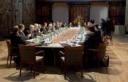
 В анализ на EUobserver има интересни наблюдения както за Съюза, така дори и за присъединяването на България, която вече участва в обсъжданията. Текстът под снимката казва, че при 27 участника край масата повечето от тях ще остават мълчаливи през повечето време.
[Comment] Too much cheese, too few threats
24.03.2006 – 09:56 CET | By Peter Sain ley Berry
EUOBSERVER / COMMENT – “How can anyone govern a country that has two hundred and forty-six different kinds of cheese?” the former French president and wartime leader General Charles de Gaulle is famously supposed to have remarked.
At least that is the popular perception, for, as so often happens, what he in fact said was something rather different: “In the absence of an external threat, how can anyone govern a country …. etc.”
It was thus the absence of threat that formed the thrust of his remark, not the multiplicity of cheeses. He meant that France – being composed of such independent-minded and heterogeneous communities, both political and geographic – would only pull together under some species of external danger.
The remark is still as relevant to contemporary France as to the one of yesteryear. The students continue to have revolting tendencies and generally the factions whether of the right or the left, rural or urban, continue to be fiercely heterogeneous.
Spring summit
For all I know there may now be an even greater variety of cheeses. Certainly it is still produced and sold unwrapped with scant regard to the substance of European directives on the subject.
And as, about this at least, one and all would fight to keep it so, the percipience of the General’s observation is nicely demonstrated.
What is true of France is equally true of the European Union as a whole and this verity will no doubt be in evidence during the current tête à tête between government leaders that is the Spring European Council.
The heterogeneous, not to say, fissiparous tendencies of the 27 states of the Union are demonstrated daily. (I include Romania and Bulgaria in the list, even though, technically speaking, they are not yet members being, so to speak, on probation and having one foot under the table rather than the usual two – a situation that will last until next year; or maybe even the one after that, if someone wishes to make a negotiating stand).
The economy, the prime subject for the spring council, illustrates the point. While everyone wants to see stronger growth and more jobs, there are fundamental divergences of view between states whose interests split in various directions.
They divide between old and new, between agricultural and industrial, between those with flexible and those with more controlled labour markets and, the irritant of the moment, between those states, like Britain, that consider economic protection of their major domestic corporations to be foul play and those, like France, who don’t.
As the number of countries in the European family increases so does the difficulty of achieving any worthwhile agreement; the perceived advantage of compromise being simply diluted as the numbers grow.
Three splits
Moreover, besides the economy, the countries of the EU are similarly split over at least three other fundamental policy pillars – the Constitution, of course, whether it should be taken forward and if so how; future enlargement (or, if you prefer, absorption capacity); foreign and security policy; and, in its widest sense, the budget – how much should the EU be spending and to what ends?
The spring council will touch on all these issues, but the outcome is unlikely to be remembered as momentous.
In fact it is more likely to lead to questions as to whether Europe’s heads of state and government and their ministerial and official retinues do not really have anything better to do with their time.
With 27 round the table most must remain passive most of the time. If all were to speak on equal terms, and allowing for the inevitable late start, each would have no more than two minutes in every hour. No wonder the small countries feel squeezed.
In such a situation little can be achieved but a papering over the cracks left in some set of already blandly written conclusions.
Though high-flown phrases about ‘being committed’ and ‘strenuous efforts’ remain, the meat has been filleted out, or rather never put in, the kitchen being unable to decide between beef or lamb filling in the sandwiches.
Pioneering groups
So without some constitutional reform to override the domestic interest and in the absence of any obvious external danger with which to galvanise itself into action, the EU seems condemned to make plodding progress only on relatively minor issues for the foreseeable future.
This in itself creates pressure for some states to create pioneering groups.
In the matter of constitutional reform we are in a chicken and egg situation, a kind of logical paradox: without constitutional reform we may never be able to reform the constitution.
As for external danger this was great enough when the Union was conceived. Soviet tanks and missiles, stationed on what is now EU territory, pointed their payloads at the main Western capitals.
There may be nothing physically comparable today, but threats there are nevertheless: world poverty is one, with its associated mass economic migration and political instability.
The fragility of a world economic order that depends on a dollar whose value is propped up by little more than wishful thinking, is another.
Catastrophes, whether as a result of climate change, a Vesuvian eruption or even a mutated avian flu virus could be devastating to the Union. And despite the Basque separatist group ETA’s welcome announcement of a permanent cease-fire, international terrorism will no doubt prove an ever-present danger.
Such threats may not be immediately compelling nor perceived sufficiently strongly to make the countries of Europe fall into line and become ‘governable’ in the Gaullist sense.
Until such time as they are we may have to put up with limited progress, while member states occupy themselves with domestic interests.
‘Retournons à nos moutons,’ they might say, or maybe even our cheeses.
The author is editor of EuropaWorld
Your comments are welcome debate@euobs.com

